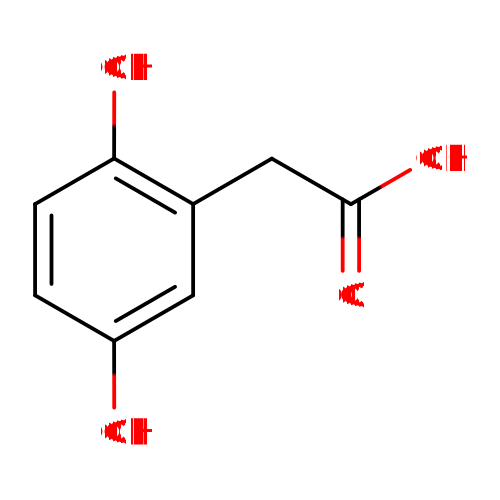
Showing chemical card for Homogentisic acid (CFc000000084)
Record Information
Version
1.0
Creation Date
2022-08-28 10:25:12 UTC
Update Date
2022-09-13 18:44:23 UTC
Chemfont ID
CFc000000084
Molecule Identification
Common Name
Homogentisic acid
Definition
Homogentisic acid, also known as melanic acid, is an intermediate in the breakdown or catabolism of tyrosine and phenylalanine. It is generated from the compound p-hydroxyphenylpyruvate through the enzyme p-hydroxyphenylpyruvate dehydrogenase. The resulting homogentisic acid is then broken down into 4-maleylacetoacetate via the enzyme homogentisate 1,2-dioxygenase. Homogentisic acid is also found in other organisms. For instance, it can found in Arbutus unedo (strawberry-tree) honey, in the bacterial plant pathogen Xanthomonas campestris as well as in the yeast Yarrowia lipolytica where it is associated with the production of brown pigments. Homogentisic acid can be oxidatively dimerized to form hipposudoric acid, one of the main constituents of the 'blood sweat' of hippopotamuses. When present in sufficiently high levels, homogentisic acid can function as an osteotoxin and a renal toxin. An osteotoxin is a substance that causes damage to bones and/or joints. A renal toxin causes damage to the kidneys. Chronically high levels of homogentisic acid are associated with alkaptonuria (OMIM: 203500 ), an inborn error of metabolism. Alkaptonuria is a rare inherited genetic disorder in which the body cannot process the amino acids phenylalanine and tyrosine. It is caused by a mutation in the enzyme homogentisate 1,2-dioxygenase (EC 1.13.11.5), which leads to an accumulation of homogentisic acid in the blood and tissues. Homogentisic acid and its oxidized form benzoquinone acetic acid are excreted in the urine, giving it an unusually dark color. The accumulating homogentisic acid (and benzoquinone acetic acid) causes damage to cartilage (ochronosis, leading to osteoarthritis) and heart valves as well as precipitating as kidney stones and stones in other organs. More specifically, homogentisic acid can be converted to benzoquinone acetic acid (BQA), and the resulting BQA can be readily converted to polymers that resemble the dark skin pigment melanin. These polymers are deposited in the collagen, a connective tissue protein, of particular tissues such as cartilage. This process is called ochronosis (as the tissue looks ochre); ochronotic tissue is stiffened and unusually brittle, impairing its normal function and causing damage. Homogentisic acid is the primary precursor of melanin synthesis in Vibrio cholerae.
Belongs to the class of organic compounds known as 2(hydroxyphenyl)acetic acids. These are phenylacetic acids that carry a hydroxyl group at the 2-position.